

September 2026 Meeting Roundup
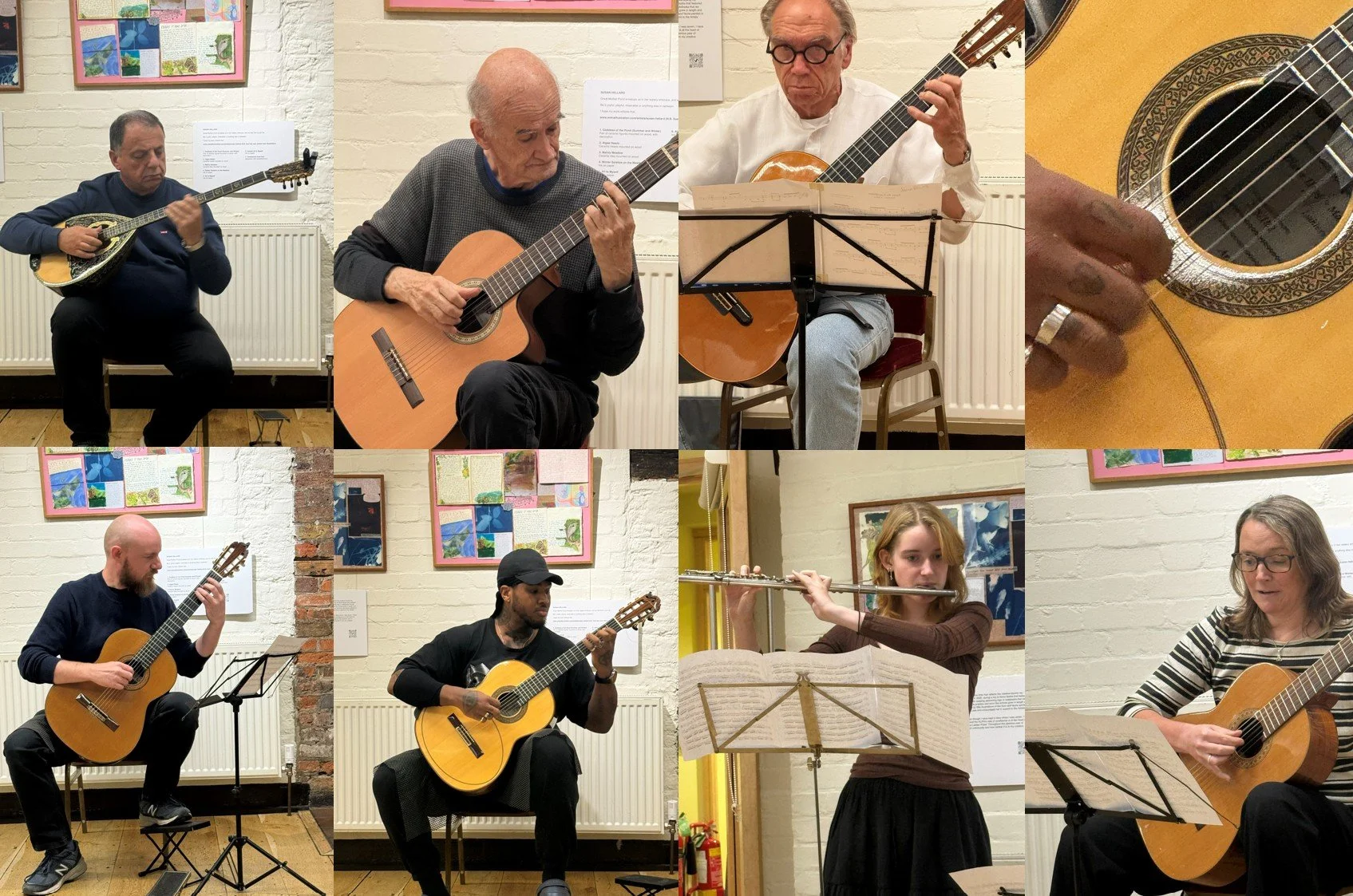
A evening filled with music and comradery
It was fantastic to see another strong turnout at our September meeting and, even more importantly, to see the Lauderdale Guitar Society continuing to grow from strength to strength.
One of the things that makes our evenings so enjoyable is the sheer variety and quality of the music being shared. Each month our players bring something different to the programme, including well-known favourites, less familiar works, their own transcriptions and arrangements, and occasionally their own compositions. September was no different and turned out to be a wonderfully varied evening of music, and a great reflection of what the Lauderdale Guitar Society is, a place where players can share music they love, discover something new, and enjoy performing in a friendly and supportive setting.
Unfortunately, Oswaldo wasn't able to join us this month. He had planned to perform two of his own compositions, including Far From Here, Far From Now, which, as it turned out, proved to be a rather appropriate title! We hope it won't be too far from here or too far from now before we get the chance to hear it.
In addition, John, who had worked hard preparing Pavan No. 3 by Luis Milán, and Alan, who had also intended to play for us, were unfortunately unable to make it at the last minute. We hope they will both be able to share their pieces with us next month.
A huge thank you, as always, to everyone who played and to everyone who came along to listen and support the performers. We look forward to seeing you all again at our next meeting.
What we played
Petros – a tribute to Mikis Theodorakis
Petros opened the evening with a particularly fitting tribute to the great Greek composer Mikis Theodorakis, who died on 2 September 2021, almost exactly five years before our September meeting.
Playing the bouzouki, Petros began with Kaimos, meaning sorrow or grief, before giving us one of Theodorakis's most instantly recognisable pieces, Zorba the Greek. With the anniversary falling in the same month, Kaimos made a particularly poignant opening and a fitting tribute to Theodorakis's memory and extraordinary musical legacy and Zorba the Greek a fitting celebration of his life. Theodorakis himself also wrote a small number of works for guitar, including his Rhapsody for Guitar and Orchestra, providing another nice connection with the Society.
Later in the evening, Petros treated us to one more Greek favourite, “Never on Sunday”, the title song from the 1960 film of the same name. Written by Manos Hadjidakis, it won the Academy Award for Best Original Song and went on to become one of the best-known Greek songs internationally.
Petros also told us a little about the instrument itself, including that his bouzouki is tuned C–F–A–D. This is standard tuning of the modern four-course Greek bouzouki follows an interval pattern closely related to the guitar. We hope that Petros will bring his bouzouki along to future meetings.
Avron – Lágrima
Avron followed with Francisco Tárrega’s Lágrima , meaning teardrop, a short piece that needs no introduction to classical guitarists with a story that gives its beautiful simplicity particular emotional weight. According to the traditional account, Tárrega conceived Lágrima while performing in London in 1881, when he was feeling melancholy and homesick for his native Spain.
The piece also has a personal resonance for Avron. Having moved from South Africa to the UK, he finds something familiar in the idea of remembering another country and another time from far away. In his interpretation, he tries to take the listener on that emotional journey. The opening A section in E major evokes a warm and nostalgic memory; the contrasting B section in E minor brings more turbulent and unsettled feelings; and, when the opening section finally returns, the same memory is heard again, but now with a sense of quiet and peaceful acceptance.
Nick – a tribute to the Sainz de la Maza brothers
Nick began with Eduardo Sainz de la Maza’s Homenaje a la Guitarra “Homage to the Guitar.” As Nick remarked before playing, he has certainly owned a few guitars in his life that he could happily pay homage to!
Eduardo Sainz de la Maza devoted much of his musical life to the guitar. An important part of his work as a composer was his desire to expand the guitar's repertoire with original music written specifically for the instrument, rather than relying so heavily on transcriptions. Homenaje a la Guitarra, dedicated to his brother Regino, is a beautiful expression of that commitment.
There is also a rather lovely LGS connection to the piece. Oren Myers, the luthier who made Avron's guitar, has himself played Homenaje a la Guitarra on one of his instruments. You can hear Oren playing the piece in this interview and demonstration which you can listen to here.
Nick then turned to Eduardo's elder brother, Regino Sainz de la Maza, with his Zapateado. The title refers to a Spanish dance famous for its rapid and strongly rhythmic footwork, and Regino's piece captures that character wonderfully. Listening to its driving rhythms, it is almost possible to imagine the missing dancer the tapping and stamping of feet and the clacking of castanets accompanying the guitar. I dare say a few of us had to restrain ourselves from the urge of tapping our own heels at Nick's request.
Regino was not only a composer but one of the leading Spanish guitarists of his generation. Joaquín Rodrigo dedicated his Concierto de Aranjuez to him, and Regino gave the work its world premiere in Barcelona in 1940. The concerto that would become perhaps the most famous work ever written for guitar and orchestra therefore began its performing life in his hands.
Brian – Melodia de uma noite
Brian played Silvestre Fonseca’s Melodia de uma noite, meaning Melody of a Night, a beautiful contemporary miniature written for solo guitar and dedicated to the Brazilian guitarist Edson Lopes.
Much of the piece's charm lies in its harmony. Set within an E-major framework, the music moves through beautifully contrasting major and minor colours and unexpected chordal changes, giving the melody a wonderfully dreamy, almost nocturnal quality. Brian brought out those shifting colours beautifully, allowing the harmonies beneath the simple melody to create much of the atmosphere of the piece.
Sara and Carrie – a mother-and-daughter duo
Sara was joined by her daughter Carrie on flute, performing Duo No. 1 from Ferdinando Carulli’s Deux Duos pour Guitare et Flûte, Op. 158. As Sara noted, we tend to associate Carulli with the enormous amount of music he wrote for the guitar, including his many works for two guitars, so it was a delight to discover one of his works pairing the guitar with the flute. Carulli was a remarkably prolific composer and also wrote chamber music combining the guitar with other instruments, helping to give the guitar a place beyond purely solo and guitar-ensemble repertoire.
Sara and Carrie played absolutely fantastically together. The flute's singing melodic line and the lighter, more intimate sound of the guitar complemented one another beautifully, bringing Carulli's music vividly to life. Hearing mother and daughter playing together made the performance particularly special.
Fahran – El Decamerón Negro
The centrepiece of the evening came from Fahran with a quite extraordinary performance of Leo Brouwer’s El Decamerón Negro. This is a substantial and technically formidable work, and Fahran played it with remarkable assurance, control and musicality. It was an exceptional performance of an exceptionally demanding piece.
As Fahran explained before playing, Brouwer's three-movement work draws its inspiration from African folktales collected by the German ethnologist Leo Frobenius, weaving together the story of a warrior, musician and lover.
In “The Harp of the Warrior”, we meet a warrior who longs to be a musician and play the harp. His choice conflicts with the expectations of his people and ultimately takes him away from his tribe, although his qualities as a warrior are later needed once again. “The Flight of the Lovers through the Valley of Echoes” takes us into the love story, as the warrior and his beloved flee together, with Brouwer brilliantly suggesting their galloping escape and the echoes sounding through the valley. Finally, “Ballad of the Maiden in Love” turns towards the lovers themselves, bringing a more lyrical and tender voice to the story.
The result is music that asks an enormous amount of the guitarist technically while also requiring the performer to tell a story; moving between strength, urgency, tenderness and lyricism. Fahran's performance brought all of those contrasting worlds vividly to life.
Jake – Legnani's Caprices
Jake performed Caprices Nos. 1, 2 and 7 from Luigi Legnani's 36 Caprices, Op. 20.
As Jake mentioned in his introduction, there is a fascinating connection here with Legnani's great Italian contemporary, Niccolò Paganini. Paganini had written his celebrated 24 Caprices for solo violin, extraordinary works designed to explore both the musical and technical possibilities of his instrument. Legnani's set of 36 Caprices for guitar is generally considered to have been inspired by Paganini's example, translating that same spirit of virtuosity and exploration to the guitar.
Legnani's Caprices journey through the major and minor keys and explore an extraordinary range of guitar technique; from scales and arpeggios to chords, legato passages and rapid changes of texture. But they are much more than technical studies. Each is a compact musical character piece in its own right. Jake gave us three contrasting examples with Nos. 1, 2 and 7, offering a glimpse into a collection that remains one of the great virtuoso achievements of the 19th-century guitar repertoire.
Oakwood Guitar Trio – from swing to Bach
The Oakwood Guitar Trio (Sara, Ken and Serge, formerly the SKS Trio) gave us two pieces that could hardly have been more different in character.
They began with Dieter Kreidler's Fun for Three, part of a collection of three swing pieces written specifically for three guitars. Light, rhythmic and unmistakably modern in character, it showed the guitar trio in a relaxed and playful guise.
They then moved into an entirely different musical world with J.S. Bach's Sinfonia No. 3 in D major, BWV 789, also known as the Three-Part Invention No. 3. Originally written for keyboard, its three independent contrapuntal voices transfer particularly naturally to a guitar trio, with each player able to bring one of Bach's interweaving musical lines to life.
Taken together, the two performances provided a wonderful miniature demonstration of the extraordinary range of music that can be played on the classical guitar, moving in just a few minutes from the swing rhythms of a contemporary work written for three guitars to the intricacy and elegance of Bach's Baroque counterpoint.
These two pieces also perfectly summed up the character of the Oakwood Guitar Trio, bringing lightness and seriousness together in a beautifully balanced and way.
Ken – Sons de Carrilhões and Milonga
Ken began with João Pernambuco's Sons de Carrilhões, meaning Sounds of the Bells, one of the best-known pieces in the Brazilian guitar repertoire.
For those of us who couldn't quite remember what the “bells” in the title referred to, they are not, as we might imagine, church bells. As Robert has reminded us at a previous meeting, the piece is said to have been inspired by sounds Pernambuco remembered from his childhood in the Brazilian backlands. Ox carts could be fitted with metal rings that struck against the wheel hubs as the carts travelled over the rough ground, producing distinctive bell-like chimes. Pernambuco, who had worked around ox carts and as a blacksmith when he was young, transformed those remembered sounds into music. I have dug up a short clip of Brazilian ox carts which is worth a quick watch to help get an immersive contextual understanding.
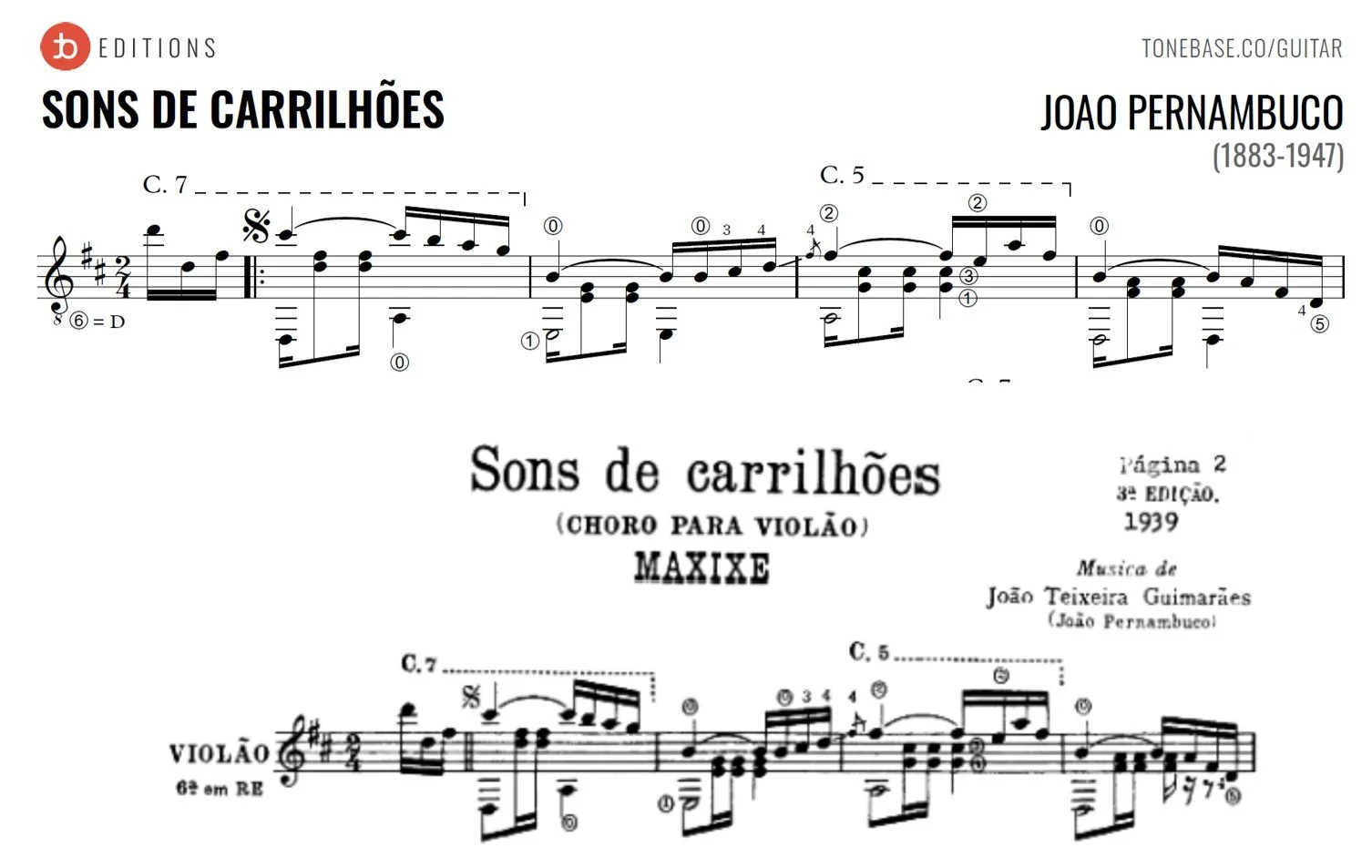
There is another interesting aspect to Sons de Carrilhões. As with many composers of the time, there isn't just one version of it. Differences can be found between the early published score and Pernambuco's own recording, and generations of guitarists have subsequently interpreted and arranged the piece in different ways. Our own Alan, an LGS regular of many years, also plays Sons de Carrilhões, but performs an older version that differs from the one we heard from Ken. Both versions are wonderful in their own way, and we very much hope Alan and Ken will play this piece for us again at a future meeting so that we can hear and enjoy the differences for ourselves.
For those of you who want to explore the differences in character, I have provided below the opening bars of two editions. The difference in rhythmic flavour is clearly displayed in the 2nd measure after the anacrusis. I personally have played the top example but fell in love with the bottom after hearing it. Unfortunately unlearning a piece seems to be harder than learning piece and so I remain with the first. Which do you prefer?
Ken followed this with Juan Buscaglia's Milonga. Buscaglia was an Argentine composer and guitarist, and the milonga belongs to the distinctive musical tradition of Argentina and Uruguay that is closely related to – and predates – the tango. With its characteristic rhythmic pulse, the piece brought another distinctly South American flavour to Ken's performance.
In Robert's absence, Ken did a remarkable job of keeping Latin America's influence on classical guitar present in our meeting.
Dennis – Villa-Lobos Prelude No. 1
Dennis gave us Heitor Villa-Lobos's Prelude No. 1, one of the composer's best-loved works for solo guitar. Dennis played it well on Ken's Yulong Guo guitar. An instrument which allowed Dennis to draw out the rich, lyrical character of the Villa-Lobos beautifully.
On a night filled with tributes, it is a perfect time to sit back and reflect on the contribution that Dennis has made to the Lauderdale Guitar Society for decades.
