

August 2026 Meeting Roundup
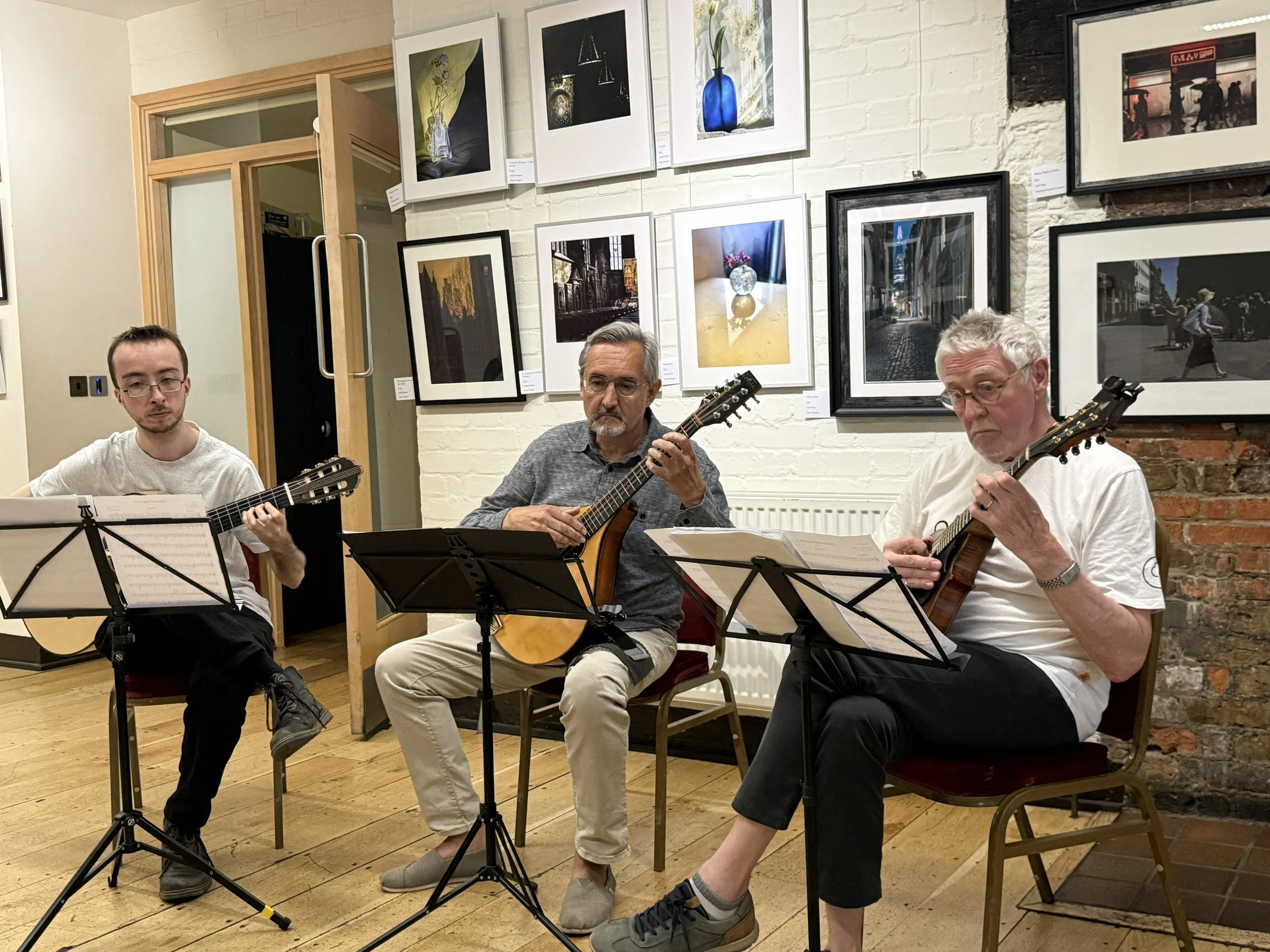
Once again, despite another of this summer's seemingly endless heatwaves, we managed to bring together a disparate group of people united by a shared enthusiasm for the classical guitar and the wider family of plucked instruments. Lauderdale House, set in the fantastic grounds of Waterlow Park was the perfect setting for an evening of music, although the normally green landscape has temporarily been browned by the prolonged drought and hosepipe bans. Alan was very much missed. Unfortunately, he was unable to join us on this occasion. He had intended to play three Lennon and McCartney songs: Here, There and Everywhere, In My Life and I'll Follow the Sun. We very much hope that Alan will be able to join us next time and that we shall then have the opportunity to hear what he had prepared.
Steven made a particularly interesting observation. Had a gathering like ours taken place around a hundred years ago, it would very likely have brought together not simply guitarists, but players of the mandolin, banjo and guitar. During the early decades of the twentieth century, banjo, mandolin and guitar (BMG) clubs and orchestras flourished around the UK. These societies brought together amateur and professional players to perform, learn from one another and, above all, enjoy the shared experience of making music on plucked and fretted instruments. So there was something rather pleasing about our August meeting. A century after the heyday of those BMG clubs, Lauderdale Guitar Society found itself, in its own small way, keeping that tradition alive. Alongside our classical guitarists we welcomed the Mezzacapo Mandolin Trio (Stuart and Rob on mandolin, with Steven on guitar) while Steven treated us to a range of works on the banjo.
Taken as a whole, the evening was a reminder of just how wide the world of plucked-string music can be: Dowland, Bach, Scarlatti, Handel and Couperin; Sor and Clara Schumann; Satie, Barrios, Castelnuovo-Tedesco, Torroba and Lauro; and then ragtime, jazz and Latin-influenced music; with Lennon and McCartney waiting in the wings for another day.
Perhaps Steven's observation therefore captured something important. The instruments, repertoire and circumstances may have changed over a hundred years, but the basic idea has not: people with a shared love of plucked instruments coming together, playing for one another, listening, talking about music and keeping a tradition alive. If the old BMG societies could somehow have dropped in on us on this particularly warm August evening, we rather hope they would have recognised something familiar.
The Music
🎵 The Mezzacapo Mandolin Trio provided particularly appropriate bookends to the evening. They opened with Clara Schumann's Prelude & Fugue No. 3 and Cécile Chaminade's Idylle, before returning later with a very different trio of pieces: Demetrio's Sway, George Shearing's Lullaby of Birdland and Mathis's La Morenita.
Clara Schumann's fugue highlights the extraordinary amount of study that can lie behind the music we enjoy. In 1845 Clara and Robert Schumann undertook an intensive study of counterpoint, fugues and canons, immersing themselves particularly in the music of J. S. Bach. Clara's Three Preludes and Fugues, Op. 16 emerged from this period of concentrated study. There is something rather appealing about the image of Clara and Robert sitting together and wrestling for hours with the complexities of fugue, and it added another dimension to hearing the music that evening.
The second piece in the trio's opening set, Cécile Chaminade's Idylle, has an interesting history of its own. It is the third of her Six Romances sans paroles, Op. 76, a collection originally written for solo piano and published in 1893. The title, Romances without Words, places the collection in a tradition most famously associated with Mendelssohn's Songs Without Words: music in which the instrument is asked, in effect, to sing without the aid of a voice.
Chaminade herself is a figure well worth rediscovering and we are privileged that Stuart has spent so much time digging up these works and arranging them for us. A French pianist and composer born in 1857, she enjoyed considerable international success during her lifetime, touring widely in Europe and America and leaving a catalogue of nearly 400 works, the great majority of which were published. Her career also included a remarkable first. In 1913 Chaminade became the first female composer to receive the Légion d'Honneur, France's highest national order of merit. It seems particularly appropriate, then, that an evening which began with Clara Schumann should continue with another woman composer whose music and achievements deserve to be much better known.
🎵 Petros took us into two very different corners of the classical guitar repertoire with Agustín Barrios's Julia Florida and Scarlatti's Sonata K10. Barrios represents one of the great guitarist-composers of the twentieth century, while Scarlatti takes us back much further and provides another example of how effectively music conceived for another instrument can find a new voice on the guitar.
🎵 Avron played Erik Satie's Gymnopédie No. 1, bringing one of the composer's most immediately recognisable and atmospheric works to the guitar.
Avron explained that he has set himself a particular challenge with this piece: to play it entirely from memory. He has reached the point where he can successfully play it from memory at home, and the next hurdle is perhaps the hardest one of all, being able to rely on that memory under the very different pressures of a live performance. He came remarkably close, playing the piece from memory with only a few small slips along the way. It was an interesting reminder that knowing a piece by heart in the comfort of home and trusting that memory when performing in front of an audience are two quite different things. Hopefully those last few uncertainties will soon be ironed out, and we look forward to hearing Avron conquer that final barrier at one of our meetings in the near future.
For anyone inspired by Avron's efforts, Alan Matthews' Woodshed programme includes a particularly useful approach to developing secure musical memory. You can watch Alan explaining his technique here.
🎵 Richard chose two movements from Mario Castelnuovo-Tedesco's Sonata: the Andantino, quasi canzone and Tempo di minuetto.
Richard has been working on this Sonata for several years now, and it has been an absolute delight for those of us who have heard it along the way to watch his relationship with this wonderful piece develop. Each time Richard returns to it, he seems to extract still more from the music, finding greater nuance, character and subtlety within it.
The two movements he chose for this meeting were wonderfully executed and a delight to listen to and provided another glimpse of what can happen when a player lives with a substantial piece of music over a long period of time: it continues to reveal more, both to the performer and to those listening.
🎵 Nick tackled the Fugue from J. S. Bach's Sonata No. 1 for solo violin, BWV 1001. As Nick explained before playing, this particular fugue has enjoyed a fascinating existence beyond the work for which it was originally composed.
Bach's original is the second movement of the Sonata No. 1 for solo violin in G minor, BWV 1001, written in 1720. But the music subsequently appeared in other guises. A version survives for lute as BWV 1000, preserved in French lute tablature associated with Bach's contemporary Johann Christian Weyrauch. Exactly how much of that arrangement is Bach's own work remains a matter of scholarly debate, since no autograph manuscript by Bach survives. There is also an organ version in D minor, BWV 539, although that arrangement is generally regarded as the work of another hand rather than Bach himself. Then comes the guitar. Modern guitarists have naturally been drawn to the piece, but the guitar presents its own possibilities and practicalities. Although Bach's violin original is in G minor, guitar transcriptions are frequently heard in A minor, a transposition that allows the instrument's open strings and resonance to work particularly effectively. Different editors and performers have also gone back variously to the violin original and the surviving lute version when creating their guitar arrangements.
So what Nick gave us was not simply a transcription of a violin piece, but the latest stage in a rather wonderful journey: the same fugue moving from violin to lute, organ and eventually the modern classical guitar, changing subtly as each instrument finds its own way of accommodating Bach's contrapuntal writing.
🎵 The SKS Trio then changed the mood completely with Kemp's Jig, Wedding Tarantella and The Entertainer. And, as with so much of the evening, the music came with stories.
Kemp's Jig led us back to the extraordinary figure of William Kempe, one of the great comic performers of the Elizabethan stage. Kempe was an actor, dancer and clown, a member of Shakespeare's Lord Chamberlain's Men, and is associated with some of the great comic roles of the period. But around 1600 he became famous for a rather different sort of performance.
Kempe set out to Morris-dance from London to Norwich, a journey of more than 100 miles. Despite what the name of his subsequent account might suggest, he did not complete the whole journey in nine consecutive days. The adventure stretched over several weeks, with nine actual days of dancing, interspersed with stops, delays and considerable hospitality along the route. To make sure there could be no accusations of cheating, he even travelled with an overseer whose job included ensuring that the feat was performed according to the rules.
Kempe subsequently wrote his own account of the escapade, and even by Elizabethan standards its title is magnificent: Kemps Nine Daies Wonder: Performed in a Daunce from London to Norwich. The original title page goes on at considerable length, promising an account of the “pleasure, paines and kinde entertainment” he encountered during his Morris dance. Published in 1600, it was partly Kempe's attempt to set the record straight after exaggerated and inaccurate stories about his exploits had begun circulating.
It is hard not to like the idea that, more than four centuries later, this extraordinary piece of Elizabethan showmanship should still leave its echo in a little jig and that the story behind the music should find its way into a Lauderdale Guitar Society evening.
The trio followed this with the Wedding Tarantella, introduced as a traditional Italian wedding dance. With its quick movement and irrepressible rhythmic energy, it brought an entirely different kind of dance tradition into the room, a neat leap from the Morris dancing of Elizabethan England to the exuberance of an Italian celebration.
And then came Scott Joplin's The Entertainer. Before the trio had properly got underway, Ken's creative opening brought an immediate mischievous smile to his face and delight to all of us present, adding an unexpected little moment of fun before the three players settled into the familiar strains of Joplin's rag. What followed was a wonderfully enjoyable performance, and a fitting end to a set that had taken us from Elizabethan eccentricity, through an Italian wedding, to the world of American ragtime.
🎵 Steven then exchanged the guitar for the banjo, opening his solo contribution with Federico Moreno Torroba's Fandanguillo. It appeared to be a fiendishly finger-twisting piece with which to begin, the sort of thing most of us might prudently have placed rather later in the programme, once fingers and nerves alike had been given a chance to warm up. Steven, however, approached it with his customary composure and assurance and simply got on with the job, making light of its considerable demands. For those that missed it, or simply want to listen again, you can do so here.
Steven also gave us Handel's Gavotte and Paul Eno's A Ragtime Episode, completing a contribution that moved from Baroque music through the Spanish repertoire to ragtime, all heard through the distinctive voice of the banjo.
🎵 Ken played François Couperin's Les Barricades Mystérieuses, in the Russell arrangement. Here again was music that began life away from the modern classical guitar but has found a very natural home on it.
🎵 Oswaldo played three contrasting miniatures: John Dowland's Sir John Smith His Almaine, Alexander Borodin's Serenade, and Antonio Lauro's Petronilla.
What made Oswaldo's contribution especially memorable was the way he introduced each piece by painting a picture of what the music evoked in his own imagination. Dowland's Almaine brought to mind the warm glow of a sunset in a forest with a nobleman riding his horse through it to the queen's banquet. A scene of movement, colour, courtly pomp and splendour and atmosphere that immediately offered a way into the piece before he had played a note.
Borodin's Serenade created a very different picture in Oswaldo's mind. Here the mood turned colder and more austere, evoking a winter landscape with pine trees standing in the snow. The contrast between the two images was striking, and Oswaldo's introductions invited us to hear the music not simply as notes and phrases, but as something capable of creating an entire landscape in the imagination.
His final piece, Antonio Lauro's Petronilla, presented a different sort of challenge altogether. It is a real workout, with its flowing arpeggio writing demanding considerable control and dexterity from the left hand. Oswaldo, in his usual manner, apologised for not being able to play it fast enough but then handled those demands fantastically well, bringing the piece off with fluency and assurance.
It is always a pleasure to hear Oswaldo perform his own compositions, where his individual musical voice is naturally at the centre. It was just as rewarding on this occasion to hear him bring well-known works by other composers to life through his own interpretation, while sharing the vivid pictures that each piece created in his imagination. His introductions and his playing together reminded us that interpretation is about rather more than reproducing the notes on the page, it can also be about finding an atmosphere, an image or an emotional landscape within the music and inviting the listener into it.
🎵 Fahran's performance of Fernando Sor's Introduction and Variations on a Theme by Mozart, Op. 9 was, without question, one of the highlights of the evening.
This piece is one of the landmarks of the early nineteenth-century guitar repertoire and a work that asks a great deal of the player, both technically and musically. Fahran's performance rose magnificently to that challenge. His tone throughout was impeccably clear, beautifully controlled and wonderfully expressive. Over and above, he brought a real sensitivity to the changing character of the music. The four variations each have their own personality and demands, and Farhan allowed each of them to speak individually while maintaining a sense of the work as a whole. There was nothing merely mechanical about the virtuosity. The technique was always at the service of the music, with changes of colour, dynamics and phrasing giving each variation its own distinctive character.
By the end, the admiration in the room was palpable. Stuart's spontaneous cry of “Bravo!” summed up what many of us were thinking and it was thoroughly deserved. It was a sublime performance of a great work and one of those moments in a Society evening when everyone in the room knows that they have just heard something rather special.
Having listened to Fahran, I went home and immediately pulled out a John Williams recording of the same piece, wanting to hear it again while the music was still fresh in my mind. And, magnificent though that recording is, I found myself preferring the experience we had just had at Lauderdale House. There is something a recording, however accomplished, cannot quite reproduce: a piece played exceptionally well, a few feet away from you, in the intimacy of a small room, with performer and audience sharing the same moment. For me, Fahran's performance was the richer experience, a wonderful reminder of why live music, and particularly music heard at such close quarters, can be so compelling.
🎵 The evening then came full circle as the Mezzacapo Mandolin Trio returned, this time exchanging their nineteenth-century opening repertoire for three pieces drawn from the popular and jazz worlds: Sway, Lullaby of Birdland and La Morenita. The trio's journey from nineteenth-century repertoire to jazz and Latin-influenced popular music also demonstrated something of the extraordinary versatility of the mandolin and guitar ensemble — and made the historical connection with those earlier gatherings of plucked-instrument enthusiasts seem particularly appropriate.
Sway has a particularly interesting double identity. The melody began life in Mexico in 1953 as ¿Quién será?, a bolero-mambo associated with Mexican composers Luis Demetrio and Pablo Beltrán Ruiz. The original Spanish lyric is rather different in mood from the song most English-speaking listeners know: it asks who the singer's next love might be. Norman Gimbel subsequently supplied an entirely new English lyric, turning it into Sway, and Dean Martin's 1954 recording with the Dick Stabile Orchestra helped make it an international standard.
From there the trio moved to George Shearing's Lullaby of Birdland, one of the great jazz standards of the 1950s, before arriving at La Morenita. And here another seemingly simple name on the programme concealed a fascinating story.
La Morenita was published under the name G. S. Mathis, but “Mathis” was in fact a pseudonym used for lighter music by Mátyás Seiber, the Hungarian-born composer who eventually made Britain his home. La Morenita itself is a tango, originally associated with Seiber's considerable body of music for accordion.
Seiber's life provides a remarkable link back into the mainstream of twentieth-century European music. Born into a Jewish musical family in Budapest in 1905, he studied composition at the Liszt Academy with Zoltán Kodály and belonged to the same Hungarian musical world as Béla Bartók. Indeed, when Seiber's Serenade for Six Wind Instruments was passed over in a composition competition in 1925, Bartók, who believed strongly in the work, left the jury in protest. Seiber subsequently helped bring Bartók's music to wider attention in Britain.
His path to the UK, however, came through much darker circumstances. Seiber later established the pioneering jazz department at Frankfurt's Hoch Conservatory, one of the earliest attempts anywhere to teach jazz academically. After the Nazis came to power in 1933, Seiber was dismissed because he was Jewish and the jazz department was closed. He returned briefly to Hungary before emigrating to the UK and settling in London in 1935.
Here he developed an extraordinary career that encompassed serious concert music, jazz, film music, folk music and teaching. He also composed and arranged extensively for accordion, sometimes using the name G. S. Mathis, which is how La Morenita found its way onto our programme.
So the trio's apparently light-hearted closing group contained rather more history than might first have appeared: a Mexican bolero-mambo transformed into one of Dean Martin's signature standards; one of the most enduring melodies of British jazz; and a tango written under a pseudonym by a Hungarian Jewish émigré whose musical world encompassed Kodály, Bartók, jazz and twentieth-century Britain.
A wonderfully eclectic way for Stuart, Rob and Steven to bring the evening to a close.
