

October 2026 Meeting Roundup
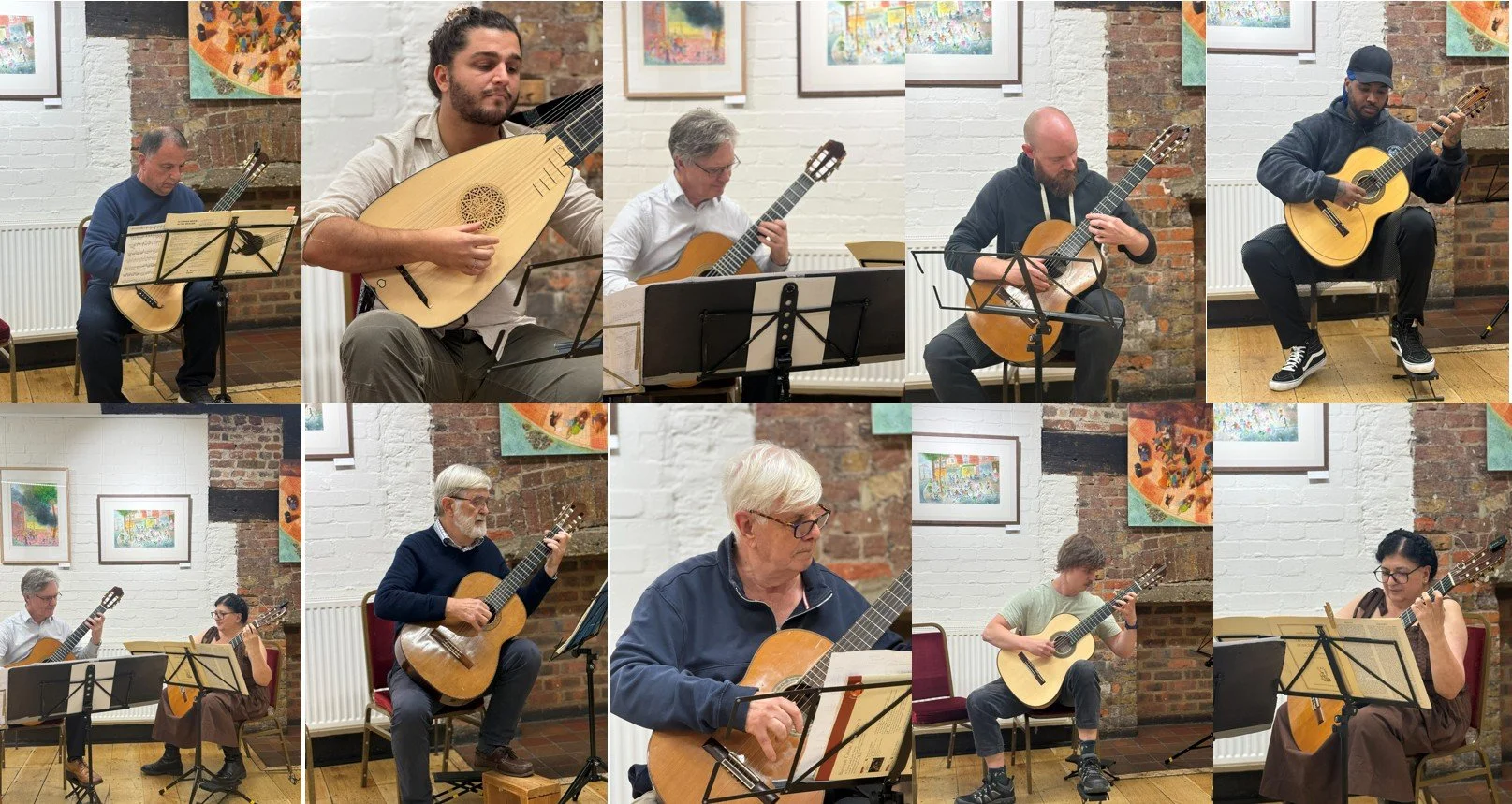
A evening filled with old and new friends
Our October meeting at Lauderdale House was another wonderfully varied evening of music, with performances ranging from Renaissance Spain and the Baroque lute to the classical guitar repertoire and contemporary original compositions.
It was particularly pleasing to welcome a number of new faces to the Society, including guests from the Hampstead Guitar Society, which is preparing to launch soon. Not only did they join us for the evening, but they also contributed some wonderful performances, adding to the richness and variety of our programme. We wish them every success with their new Society and look forward to building a close relationship between our two musical communities. Anyone interested in finding out more about the Hampstead Guitar Society, including how to get directly in touch, can click here for further information.
Several of our familiar regulars were unfortunately unable to join us this month, with commitments ranging from holidays to travelling for research, all entirely worthy pursuits! We missed them, of course, and we look forward to seeing them back in November a little more rested and a little more knowledgeable.
The evening also had a rather different flavour from our usual gatherings. For whatever reason, relatively few performers chose to introduce their pieces or share much about the music they were about to play. And, as we shall discover later, Jake went a step further by performing two original compositions that did not even have names!
For your humble newsletter writer, this was, admittedly, a little frustrating. With fewer stories, historical observations and personal insights to draw upon, there was rather less material from which to construct an account of the evening. Here was one less reason for people to read my newsletter to remind themselves of an interesting point raised.
But perhaps that is precisely the point.
It raises an interesting question about the way we experience music. Does music really need to be discussed, explained or placed within its historical context? Does a composition even need a title? Or is there something to be said for simply sitting back, listening and allowing the music to speak for itself, without any preconceptions about what we ought to hear or feel?
Of course, there is no right answer. Some of us find that understanding a composer's intentions, the circumstances surrounding a work or the instrument for which it was written adds enormously to our enjoyment. Others might argue that the purest musical experience comes from listening without explanation, allowing the sounds themselves to create their own meaning.
Perhaps the beauty of music is that it accommodates both approaches.
And while this may have left your newsletter writer with a little less to report, it certainly gave us something interesting to think about!
The Evening's Performances
Petros: Carulli and Carcassi on a Lacote Replica Guitar
Ferdinando Carulli — Sonata No. 2, First Movement
Matteo Carcassi — Study No. 24
Petros opened the evening with two works from the early nineteenth-century classical guitar repertoire, performing on a reproduction of a guitar by the celebrated French maker René François Lacote.
This was a particularly appropriate choice of instrument. Lacote was one of the most important guitar makers of the nineteenth century, producing instruments during the very period in which composers such as Carulli and Carcassi were establishing the foundations of the modern classical guitar repertoire.
Compared with today's guitars, instruments of this period were smaller, more lightly constructed and possessed a distinctive tonal character. Hearing these works performed on an instrument the composers would have played on gave us a fascinating glimpse of how the music might have sounded to audiences of the time.
John: From Renaissance Spain to the Baroque
Luis Milán — Pavana No. 3
David Kellner — Rondeau
The first, Pavana No. 3, was by the sixteenth-century Spanish composer Luis Milán, whose music represents some of the earliest surviving repertoire associated with the guitar's ancestry. John will be performing the Pavana soon and took the opportunity to play in front of a supportive and friendly audience. And this is part of what we are about at Lauderdale Guitar Society, a safe space for guitarists to come together and share music.
John followed the Pavana with a Rondeau by David Kellner, taking us into the Baroque era and demonstrating the remarkable breadth of music that can be brought to life on the modern guitar.
Alan: Bach's Second Violin Sonata
Johann Sebastian Bach — Andante from Sonata No. 2 for Solo Violin, BWV 1003
Alan gave us a beautiful performance of the Andante from Bach's Second Violin Sonata. He made an interesting observation about the relationship between the violin and the guitar. The violin is tuned in fifths, whereas the guitar is predominantly tuned in fourths, yet Bach's writing in this movement adapts remarkably naturally to the guitar.
The Andante has a wonderful flowing melodic line, supported by an implied harmonic accompaniment. On the guitar, the ability to sustain and articulate several voices offers a different perspective on Bach's extraordinary contrapuntal imagination. I thoroughly recommend listening to performances on the violin and then the guitar to see how the different instruments express the same musical idea.
It was an absolute joy to hear Alan play this wonderful music with the wonderful light touch he has. Indeed, this is so fitting with his personality.
Avron: Carcassi and Bach
Matteo Carcassi — Étude No. 7, Op. 60
Johann Sebastian Bach — Jesu, Joy of Man's Desiring
Avron continued the evening with two contrasting works, an étude by Carcassi and an arrangement of Bach's much-loved Jesu, Joy of Man's Desiring.
Carcassi's Op. 60 studies remain a cornerstone of the classical guitar repertoire, and Avron has spoken many times in the past of his inner battle with Carcassi's music which as an early teenager he felt was thrown at him when his teacher was not quite sure what to give to him next. But now being a little older, a little more patient, and inspired by Sara's rendition of it, he has tackled it again and found delight in the subtle technical challenges and some of the musical ideas and phrases.
Bach's Jesu, Joy of Man's Desiring, meanwhile, offers an entirely different musical challenge, with its familiar, gently unfolding melody and underlying harmonic movement interspersed with great organ like chords.
One of the great benefits of playing at the Society is the opportunity to receive constructive feedback from fellow musicians. Following his performance, Avron was given some thoughtful advice about perhaps driving the guitar a little too hard, rather than allowing the instrument's natural resonance and volume to sing. It was a valuable observation, gratefully received, and something he intends to explore in his future playing. After all, the Society is as much about learning from one another as it is about performing.
Emanuele Addis: The Archlute
Piccinini — Aria di Saravanda
One of the particular highlights of the evening was the appearance of Emanuele Addis, performing on an extraordinary archlute made especially for him. The archlute is a fascinating instrument, developed during the late Renaissance and Baroque periods. Its extended neck accommodates additional bass strings, giving it a distinctive appearance. Perhaps the most striking aspect of the instrument was the natural resonance of the long bass strings. Even when they were not being played directly, their sympathetic vibrations contributed a remarkable depth and richness to the overall sound. Emanuele shared with us that the strings are G F E D C Bb A G F which I believe is a G scale.
For guitarists, hearing an archlute played live is particularly rewarding. So much of our early repertoire has its origins in music written for the lute family, and hearing that music performed on an instrument closely associated with its original tradition offers a fresh perspective.
Brad: Julia Florida
Agustín Barrios Mangoré — Julia Florida
Brad treated us to a beautiful performance of Barrios's Julia Florida, despite protesting beforehand that he had not played the piece for some time. His concerns proved entirely unnecessary and he played it with the required lyricism and constraint that the piece demands. It is a piece that can easily lose some of its charm when performed too quickly. Brad, however, found a beautifully judged tempo, allowing the melody to unfold naturally and giving the music the space it needs to breathe.
The result was a wonderfully expressive performance that captured the flowing, almost dreamlike quality of the composition.
Therese and Ienne: Giuliani's Polonaise Concertante
Mauro Giuliani — Polonaise Concertante, Op. 137, No. 1
Therese and Ienne brought us back to the early nineteenth century with a superb performance of Giuliani's Polonaise Concertante. Giuliani needs no introduction to as one of the greatest guitar virtuosos of his generation and a prolific composer of chamber music.
Therese and Ienne played wonderfully together and we look forward to hearing more at the next meeting in November.
Jake: Two Original Compositions
Two Untitled Original Works
Jake offered something quite different, performing two of his own compositions, played consecutively.
Interestingly, neither piece has been given a title as Jake mentioned he struggles to come up with names for pieces but also does not wish to constrain the music by giving it a tile, bringing us back to the question raised at the beginning of this newsletter: does music really need a name?
Titles can certainly help establish a mood, suggest a narrative or guide the listener towards a particular interpretation. Yet they can also influence our expectations before a single note has been played.
There is something rather liberating about listening to a piece without being told what it is supposed to represent. The listener is free to discover their own meaning, associations and emotional response.
After all, much of the instrumental music we admire is identified simply by its form, key or catalogue number.
Jake's two compositions offered us an opportunity to listen without preconceptions and to allow the music to speak entirely for itself.
Fahran: Giuliani's Grande Ouverture
Mauro Giuliani — Grande Ouverture, Op. 61
Fahran followed with a magnificent performance of Giuliani's Grande Ouverture, one of the great concert works of the classical guitar repertoire.
Written in the style of a dramatic operatic overture, the piece demonstrates Giuliani's remarkable ability to create the impression of an orchestral work on a single guitar.
Its contrasting sections, virtuosic passages and dramatic changes of character demand considerable technical command and musical understanding.
Fahran delivered a performance that was flawless from beginning to end, bringing out both the grandeur and the delicacy of the music.
It was a joy to listen to and a fine demonstration of just how much musical drama a single guitar can produce.
A Wonderful Musical Finale
As the evening progressed, we had a little time left over and so were treated to several additional performances, bringing together some of the great composers of the guitar and lute repertoire.
Petros: Carcassi's Étude No. 3
Matteo Carcassi — Étude No. 3
Petros returned with another work by Carcassi, reminding us of the enduring appeal of the composer's studies.
Although conceived partly as educational works, Carcassi's études are far more than technical exercises. They are miniature musical compositions in their own right, rewarding careful attention to phrasing, articulation and tone.
It was a welcome return to the classical guitar repertoire with which the evening had begun.
Fahran: La Catedral
Agustín Barrios Mangoré — La Catedral
Fahran returned with one of the most evocative works in the entire guitar repertoire: Barrios's La Catedral.
For a moment we were able to pause and find the inner peace and awe that can be found in a cathedral. There is something extraordinary about the ability of a single guitar to evoke such a sense of space, stillness and spiritual reflection and Fahran delivered this in truckloads.
Emanuele Addis: Bach's Prelude, BWV 998
Johann Sebastian Bach — Prelude from BWV 998
Emanuele returned to his archlute for Bach's magnificent Prelude from BWV 998.
This work is of particular historical interest because Bach's autograph manuscript bears the title Prelude, Fugue and Allegro for Lute or Keyboard. Although the precise instrument Bach intended remains a subject of scholarly discussion, BWV 998 is his only work which explicitly mentions the lute.
Brad: Recuerdos de la Alhambra
Francisco Tárrega — Recuerdos de la Alhambra
Brad brought the evening to a close with one of the most recognisable and beloved works in the classical guitar repertoire, Tárrega's Recuerdos de la Alhambra.
It is a demanding work, requiring exceptional control and evenness of touch to allow the melody to flow naturally which Brad acheived.
What a lovely way to conclude an evening that had taken us through so many centuries of music.
