

Sharing the joy of stringed instruments
November 2026 Highlights - Going from Strength to Strength!
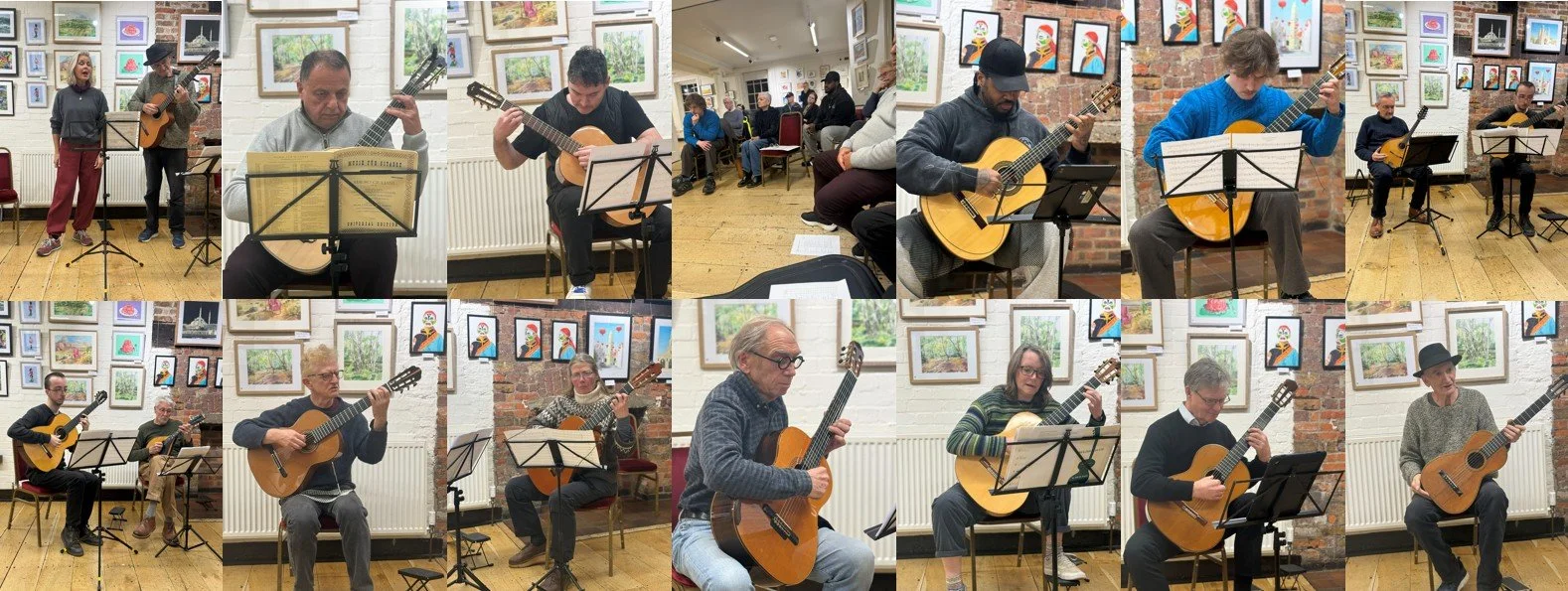
What a wonderful evening we enjoyed at Lauderdale House in November! The Society really does seem to be going from strength to strength, with another busy and thoroughly enjoyable gathering reflecting the enthusiasm, musical talent and wonderful spirit of our growing community.
We had a particularly full programme, offering a fascinating variety of music, from classical favourites to more contemporary works. Despite the number of performances, the evening flowed remarkably smoothly, thanks in no small part to Steven, who did a splendid job as our compère, keeping everything moving along with his customary good humour and efficiency.
A special thank you goes to everyone who performed, attended and helped make the evening such a success. It was particularly encouraging to see so many people coming together to share their enjoyment of music, whether as performers or as an appreciative audience.
Stuart also asked us to pass on his personal congratulations to everyone who came along and contributed to such an encouraging evening, both for him personally and for the Society as a whole. As he so aptly put it, we really do seem to be moving onwards and upwards!
It is this shared enthusiasm and support that makes Lauderdale Guitar Society such a special place to enjoy music.
1. Avron – Carcassi and Pratten
Avron opened the evening with two contrasting nineteenth-century works, beginning with Matteo Carcassi's Étude No. 7, Op. 60. Although he had performed this piece at the previous meeting, he chose to return to it after receiving some valuable feedback that he had been pushing the guitar too hard rather than allowing the instrument's natural volume and resonance to come through. Having spent the intervening month working on a more relaxed approach, he hoped that the difference would be apparent in this performance. He particularly enjoys the étude's wonderful sense of forward momentum, which seems to gather pace and energy as the piece progresses.
His second piece was A Lament, from Songs Without Words by Catharina Pratten (1824–1895). Pratten was a German-born composer who moved to the UK at the age of 4 and therefore is closely associated with British guitar music. She was one of the most influential guitarists, teachers and composers of nineteenth-century Britain. Avron had only recently discovered her music and felt that both the composer and her works deserved far greater recognition and more frequent performances. Although he felt he had not yet fully polished the piece, he was nevertheless excited to share it with the Society.
One particularly interesting feature of the score is Pratten's instruction to play a chord “walking up”. Just before the performance, Steven helpfully explained the technique: rather than simply rolling the chord in the usual manner, the player begins with a strongly articulated bass note played by the thumb, then moves gradually upwards through the remaining notes, allowing each successive note to become softer. The result is a beautifully graduated, almost cascading effect, bringing a special expressive quality to the music.
2. Stuart and Steven – Mandolin and Guitar
It was lovely to welcome Stuart back to the Society after a short break. Stuart always delights us with his mandolin playing, imaginative transcriptions and his ability to introduce us to music from unexpected sources, including works by celebrated accordion composers. Together with Steven on guitar, he treated us to three contrasting pieces.
They began with Étude mignonne No. 9 by the French pianist and composer Jean-Henri Ravina (1818–1906). Ravina was a distinguished nineteenth-century musician whose compositions were primarily written for the piano. His short, charming studies provided a delightful opening to the duo's performance.
Their second piece, Tristorosa, had a particularly interesting history. Originally composed as a piano waltz around 1910, it was written by the young Brazilian composer Heitor Villa-Lobos under the pseudonym Epaminondas Villalba Filho. The name was a tribute to his father, Raúl Villa-Lobos, who had used Epaminondas as a literary pseudonym. The work has a distinctly wistful character, reflecting the expressive side of Villa-Lobos's early musical language.
They concluded with Dans ma verdine by Jo Privat and Jean-Claude Lassagne, a piece rooted in the French accordion tradition. The title evokes the world of the verdine, a traditional travelling caravan, while also suggesting the freshness and nostalgia associated with the music. Originally associated with accordion playing, it made an interesting and charming conclusion in this arrangement for mandolin and guitar.
3. Nick and Emma – Guitar and Voice
It is always a special pleasure when Emma joins us to sing, accompanied by Nick on guitar. Emma has a wonderful voice, and her performances are made all the more enjoyable by the fascinating little insights and stories she shares about the songs. These introductions add another dimension to the music, giving us a deeper appreciation of the pieces we are about to hear.
They began with The First Time Ever I Saw Your Face, written in 1957 by Scottish folk singer and songwriter Ewan MacColl for the American singer Peggy Seeger, who later became his wife. MacColl is said to have composed the song during a transatlantic telephone conversation with Peggy. Although originally a folk song, it became internationally famous through Roberta Flack's recording, released in 1969 and propelled to enormous success in 1972 following its use in the film Play Misty for Me.
Next came Handel's exquisite Where'er You Walk, from his dramatic musical work Semele, first performed in 1744. The aria is sung by Jupiter, who promises Semele a beautiful, almost enchanted paradise, where cooling breezes, shady trees and blossoming flowers will surround her. It is a wonderfully evocative vision of a garden of delights, perfectly captured by Handel's graceful and flowing melody.
Their final piece, Se tu m'ami, se sospiri (If You Love Me, If You Sigh), offered another fascinating musical story. For many years, this charming Italian song was attributed to the eighteenth-century composer Giovanni Battista Pergolesi. However, modern scholarship has cast considerable doubt on that attribution, and the work is now generally believed to have been composed by Alessandro Parisotti (1853–1913), who published it in his celebrated collection of Italian songs in 1885.
4. Petros – Giuliani: Variations on a Theme by Handel
With a collection of no fewer than eleven guitars, Petros always seems to have a knack for choosing just the right instrument for each performance. This time, he treated us to Mauro Giuliani's Variations on a Theme by Handel, Op. 107, played on his beautiful Lacôte-style guitar.
The work takes its theme from Handel's famous The Harmonious Blacksmith, the final movement of his Suite No. 5 in E major, HWV 430. Rather than following Handel's original variations, Giuliani creates six of his own, transforming the familiar melody through a succession of contrasting musical ideas. This was a popular practice at the time, when composers delighted in taking well-known themes and demonstrating their own musical inventiveness. There was even an element of friendly competition, as musicians sought to outdo one another with ever more imaginative variations.
Petros's choice of guitar was particularly fitting, reflecting the style of instrument that would have been familiar to guitarists of Giuliani's era. Its delicate, intimate sound seemed to transport us back to the drawing rooms and musical salons of the early nineteenth century, where such music would once have been enjoyed.
5. James – Sinesi: Contramarea
James performed Contramarea by the contemporary Argentine guitarist and composer Quique Sinesi.
Sinesi's music draws on a rich variety of South American influences, including Argentine folk traditions, tango and contemporary guitar techniques. His compositions often combine rhythmic vitality with lyrical passages, creating a distinctive musical language that has made him an important figure in modern guitar music.
The title Contramarea, which James described as meaning “opposing tides”, provided a particularly evocative image for the performance. Before playing, James invited us to listen for the changing tides within the music, and he certainly succeeded in bringing that imagery to life. Through the shifting rhythms and contrasting passages, one could almost sense the ebb and flow of the water, making this a wonderfully atmospheric performance.
6. Nick – Sor: Menuetto from Grand Sonata, Op. 22
Nick returned to the stage for a solo performance of the Menuetto from Fernando Sor's Grand Sonata, Op. 22. Given the particularly full programme, Nick had graciously offered to play a shorter piece than the one he had originally intended, and we look forward to hearing his planned performance at our December meeting.
Sor, of course, needs no introduction to the Lauderdale Guitar Society, but what made this performance particularly special was Nick's choice of instrument. Following Petros's earlier performance on a replica of a nineteenth-century guitar, Nick brought along a rather different piece of history: a guitar that had belonged to his grandmother.
Unfortunately, the original maker's label has long since disappeared, leaving its origins something of a mystery. Nevertheless, the instrument continues to produce a lovely sound after all these years. Nick also shared a delightful childhood memory: having once broken a string on the guitar, he was promptly forbidden from touching it again! Happily, he eventually inherited the instrument, and we could hardly imagine a more fitting custodian for such a wonderful family treasure.
It was a pleasure to hear this historic instrument brought to life once again, particularly through the music of Sor.
7. Ienne and Thérèse – Cardoso: Milonga
Ienne and Thérèse performed Milonga by the Argentine composer Jorge Cardoso.
The milonga is a traditional musical form associated with Argentina and Uruguay, closely related to the tango but with its own distinctive rhythmic character. Ienne and Thérèse brought this out wonderfully, with the melody passing effortlessly between the two guitars, creating a delightful musical conversation.
It is always a pleasure to listen to Ienne and Thérèse. What makes their performances particularly enjoyable is the obvious pleasure they take in playing together. Watching them, one gets the impression that they are enjoying making the music every bit as much as we are enjoying listening to it. We very much look forward to hearing more from them at future Society meetings.
8. Jack – Aphex Twin: Avril 14th
Jack offered something rather different with Avril 14th by the electronic musician and composer Aphex Twin, arranged for guitar by Simon Farintosh.
Originally released in 2001 on the album Drukqs, the piece is an unusually gentle and reflective piano composition from an artist better known for experimental electronic music. Its simple, haunting melody has made it one of Aphex Twin's most widely recognised works.
Jack mentioned that he had searched long and hard to find a transcription of the piece that truly resonated with him. Listening to his performance, there was little doubt that his persistence had been richly rewarded. He brought out the delicate beauty of the music wonderfully, and it was a real pleasure to hear him play it.
9. Sara – Duarte: English Suite, Op. 31 – Prelude
Sara performed the Prelude from John W. Duarte's English Suite, Op. 31. This is not the first time Sara has brought Duarte's music to the Society, and it is always a pleasure to hear her play it.
Duarte was one of Britain's most prolific and respected guitar composers, writing more than 150 works for the instrument. His music frequently draws on traditional English melodies and dance forms, combining them with a distinctive modern harmonic language.
It was particularly pleasing to hear another British guitar composer featured in the programme, following Avron's earlier performance of a work by Catharina Pratten. Although separated by more than a century, Pratten and Duarte both made remarkable contributions to the guitar repertoire. Pratten herself is credited with composing around 250 works, a considerable achievement and another reminder of how much wonderful British guitar music there is to discover and enjoy.
We would certainly welcome hearing more music by British composers at future Lauderdale Guitar Society meetings.
10. Ken and Lorna – Philip Glass: Opening
Ken, who always seems to have a smile on his face, a sparkle in his eye and just a hint of mischief about him, treated us to a last-minute change of programme. Instead of performing Major Stars in Quy, as originally planned, he joined Lorna for a delightful duet of Opening by the American minimalist composer Philip Glass.
Originally written for piano and appearing on Glass's 1982 album Glassworks, Opening is built around gently repeating patterns and subtle harmonic changes, creating a flowing, almost hypnotic musical atmosphere.
If this is the sort of mischief Ken gets up to, we sincerely hope he gets up to more of it! It was a thoroughly enjoyable duet and a real pleasure to hear Ken and Lorna playing together.
11. Oakwood Trio – Weiss: Ciaccona
Sara, Serge and Ken performed a Ciaccona by the German Baroque composer and lutenist Silvius Leopold Weiss.
As the trio explained, the piece was originally written in G minor for the Baroque lute and appears to have been intended as a duet, probably with a flute, although a violin has also been suggested. An interesting feature of music-making in the Baroque period was that the different instrumental parts were often written on separate sheets of music, allowing each musician to read and rehearse their own part. Unfortunately, this also meant that individual parts could become separated and lost over the centuries, as appears to have happened here. Only the lute part survives, leaving modern musicians to reconstruct or arrange the missing musical lines.
For their performance, the trio explained that the work had been transposed from its original G minor into A minor to make it better suited to the classical guitar.
It was a wonderfully enjoyable performance by the trio, whose playing seems to go from strength to strength. Although they have recently changed their name, the only change we can detect in their music is that they just keep getting better and better!
12. Steven – Mompou: Prelude No. 5
Steven returned for a solo performance of Prelude No. 5 by the Catalan composer Federico Mompou, arranged for guitar by Beneteau.
Mompou's music is celebrated for its intimacy, simplicity and subtle emotional depth. His compositions often avoid grand gestures in favour of quiet reflection and delicate harmonies.
Originally written for piano, his preludes translate particularly well to the guitar, whose intimate sound suits the composer's understated musical language.
13. Rob and Steven – Mandolin and Guitar
Rob and Steven presented three contrasting pieces for mandolin and guitar, beginning with Une larme (A Tear) by Modest Mussorgsky, arranged by McGowan.
They followed this with Beethoven's Sonatina, which has a particularly interesting history. Beethoven originally composed the work for mandolin and harpsichord, an unusual combination today, but one that reflected the popularity of the mandolin in musical circles of the late eighteenth century. The piece has subsequently been arranged for other instrumental combinations, including mandolin and cello. For this performance, the accompanying part was played on the guitar, creating a delightful partnership between the two plucked instruments.
Their final piece was Porte close (Closed Door) by Dedieu-Peters, also arranged by McGowan, bringing their varied and thoroughly enjoyable selection to a close.
14. Emanuele Addis – Archlute
Unfortunately, Emanuele was unable to attend our November meeting, so we missed his planned performance of Alessandro Piccinini's Ciaccona in partite variate.
Given our particularly packed programme, perhaps it was just as well that we didn't also have to find room for an instrument the size of an archlute! Joking aside, Emanuele and his magnificent instrument were certainly missed, and we very much hope to welcome them both back to a future meeting.
15. Brad – Mascagni: Intermezzo from Cavalleria rusticana
Brad performed the celebrated Intermezzo from Pietro Mascagni's opera Cavalleria rusticana, first performed in 1890.
This beautiful orchestral interlude is one of the most recognisable pieces of Italian operatic music, renowned for its sweeping melody and deeply expressive character.
Its lyrical qualities make it particularly well suited to arrangement for the guitar, where the instrument's warmth and intimacy can bring a different dimension to the music.
What made Brad's performance particularly moving was the personal story behind his arrangement. He explained that he had originally arranged the piece to play at his grandmother's funeral, at her request. Knowing the significance of the music to him added another layer of emotion to an already deeply expressive work. Brad played it beautifully and with great sensitivity, making this a particularly touching moment in the evening's programme.
16. Fahran – Bach: Chaconne from Partita No. 2 in D minor, BWV 1004
Fahran brought the evening's programme to a close with one of the most monumental works in the classical repertoire: Johann Sebastian Bach's Chaconne from the Partita No. 2 in D minor, BWV 1004.
Fahran began by playfully referring to my previous newsletter, in which I had lamented having rather little information about some of the pieces performed, as the performers had not introduced their music at that meeting. He announced that he intended to keep me rather busier this month, and he certainly delivered!
His story of how he came to learn the Chaconne was as entertaining as it was extraordinary. Faced with a week-long series of tattoo appointments, lasting up to ten hours a day, Fahran wondered how he might occupy himself during all those hours. His solution was to take along his guitar and tackle one of the most demanding works in the repertoire — a piece he had never previously played!
Remarkably, he had begun learning the Chaconne just 25 days before our meeting, and the previous evening had been the very first time he had played it from beginning to end.
In preparing the work, Fahran explored three different guitar transcriptions. He considered Andrés Segovia's version, which appealed to him partly because it occupied a relatively manageable nine pages, alongside Manuel Barrueco's considerably longer, 23-page transcription. He also studied Carl Scheit's edition, which, although he wasn't particularly fond of its typography, contained some musical ideas he found valuable. Clearly, there is rather more to learning the Chaconne than simply choosing which notes to play!
Despite having spent less than a month with this extraordinary work, Fahran gave us a truly wonderful performance. His playing was expressive and assured, drawing beautiful sounds from the guitar and bringing out the depth and character of Bach's music. It was an absolute pleasure to end our evening listening to such a magnificent composition, played with such feeling.
Fahran hopes to return in January and perform the Chaconne entirely from memory, something we are already looking forward to with great anticipation. If this is what he can achieve in just 25 days, January promises to be something rather special!
And while Bach originally composed the Chaconne for solo violin, listening to Fahran's performance might well have persuaded some of us that the guitar is its natural home. Indeed, one cannot help wondering: had Bach possessed a modern classical guitar, might he have written the Chaconne for it in the first place?
