

April 2026 Meeting Roundup
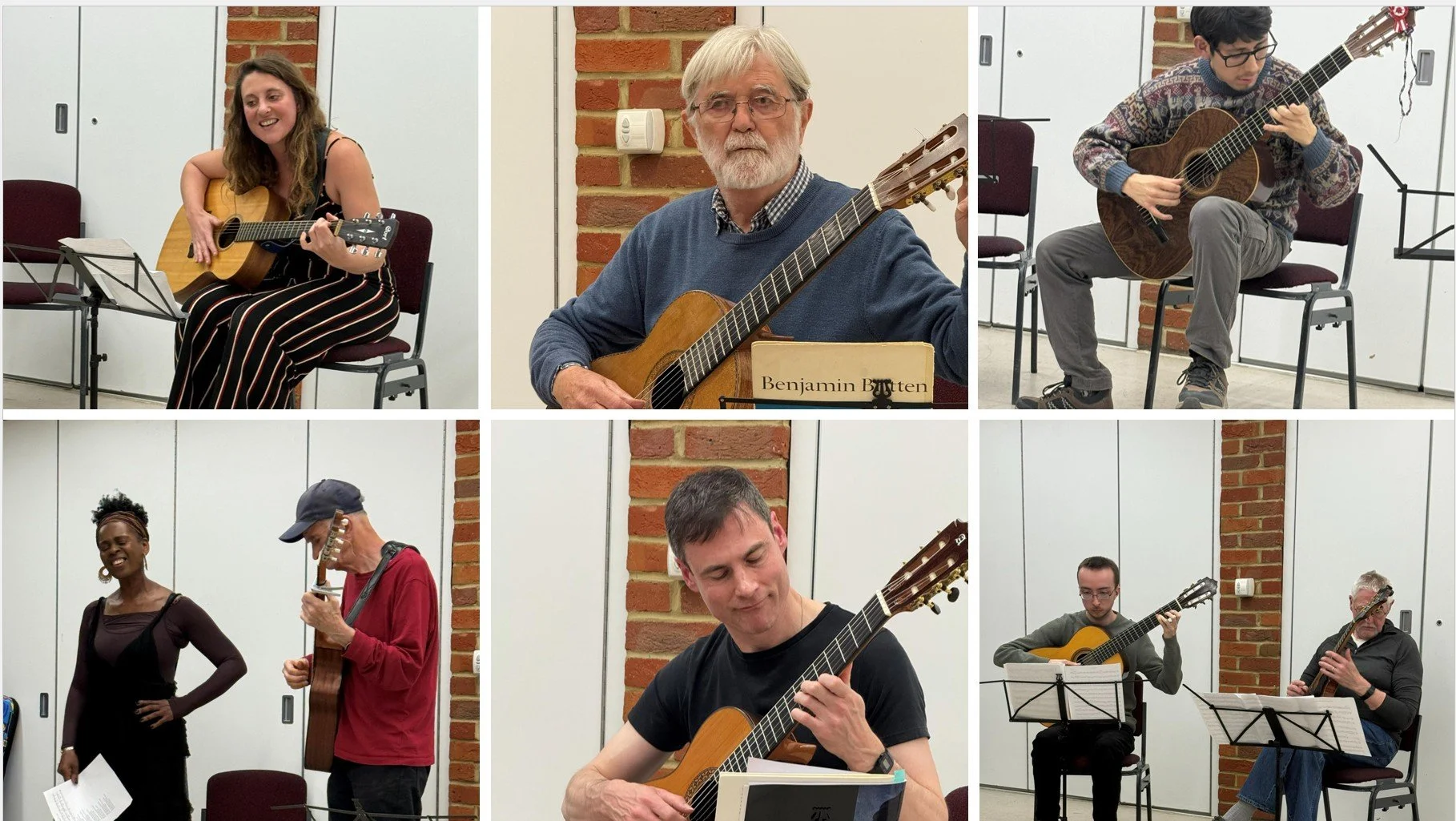
The Lauderdale Guitar Society’s April meeting brought another engaging and richly varied evening of music, reflecting the wide-ranging tastes and talents of the group. From Baroque staples and classical études to film music, folk traditions, and jazz-infused standards, the programme offered something for everyone.
Alan opened with an eclectic and expressive set, moving between Barry Norman’s Film and TV theme, Nina Simone’s I Wish I Knew How It Would Feel to Be Free, the ever-recognisable M.A.S.H. theme (Suicide Is Painless), and concluding with Dowland’s Come Heavy Sleep alongside the final movement of Britten’s Nocturnal. He mentioned that when he first encountered the Nocturnal back in the 1970s, he couldn’t quite get his head around it—but decades on, it’s clear just how far that journey has taken him, with a performance that was both assured and beautifully expressive.
Toby followed with a well-balanced classical programme, featuring Bach’s Bourrée I from Cello Suite No. 3, Coste’s Leçon in D minor, and David Cottam’s Campanella Prelude, showcasing both clarity of articulation and a strong sense of musical line.
Avron continued with a warmly received set including Bach’s Minuet in G, the ever-popular Malagueña by Ernesto Lecuona, and the traditional Red is the Rose, offering a pleasing mix of classical and folk influences. The enthusiastic response to Malagueña in particular suggests that flamenco guitarists would be a very welcome addition to future meetings.
A highlight of the evening came from Stuart and Steven, whose duo performance brought energy and character through Oriental and O Eterno Jovem Bach (Carrilho), within which listeners could clearly detect echoes of Bach’s Jesu, Joy of Man’s Desiring, followed by Homenagem à Altamiro (Ferreira). Their ensemble playing added a vibrant change of texture to the programme.
Robert introduced a South American flavour with Wawapampay (traditional Peruvian), a piece from the southern Andes in which one could clearly hear the influence of the harp and violin textures on which the transcription is based. The piece also features an unusual tuning (F♯, A, C♯, F♯, B, and E♭) with evidence of this approach to tuning dating back as far as the 1700s. He followed this with Chabuca Limeña, a Peruvian waltz often associated with coastal traditions frequently sung at funerals of children and more commonly heard along the coast than in the mountainous regions. Both were delivered with rhythmic sensitivity and charm.
Sara performed Carcassi’s Studies Nos. 2 and 13, demonstrating solid technique and musical control, bringing a focused and classical contrast to the evening.
Nick (guitar) and Marcia (voice) provided a beautifully varied vocal set, from the traditional Searching for Lambs to Jobim’s Agua de Beber, and finishing with Amy Winehouse’s Stronger Than Me. Their performance added a welcome vocal dimension and stylistic breadth.
Petros contributed Lauro’s El Negrito and La Negra, bringing warmth and rhythmic vitality through these well-loved works.
Mel brought a real sense of fun and atmosphere with Minnie the Moocher by Cab Calloway, capturing the piece’s distinctive swing and playful character. The audience were soon drawn in, joining enthusiastically in the familiar call-and-response chorus, which made for a lively and memorable moment in the evening. It was also a real pleasure to have another member combining voice with guitar, adding yet another dimension to the Society’s ever-expanding musical palette.
Stuart returned with a lively and characterful set, featuring Paris-Soir by René Ninfourge, who, remarkably, passed away recently at the age of 100, with Stuart performing his own mandolin arrangement of the original accordion piece. He followed this with a medley of traditional Irish tunes including Boys of Malin, The Gravel Walks, and Dinky’s Reel, bringing the evening a strong sense of momentum.
Steven followed with two beautifully arranged works: Bach’s Sarabande and Wagner’s Parsifal, both in arrangements by Llobet, offering a reflective and expressive contrast. Steven’s interpretation of Parsifal was sublime and had all captivated.
Dennis concluded the performances with Villa-Lobos’s Study No. 1, a fitting and energetic close to the evening.
Overall, the April meeting once again highlighted the Society’s strength in bringing together a diverse programme of music in a welcoming and supportive environment, with contributions spanning multiple styles, periods, and traditions.
